
Why flexural, tensile, impact, and abrasion performance truly govern Resin flooring durability
In resin flooring specifications, one parameter continues to dominate discussions, approvals, and even disputes — compressive strength. Frequently highlighted in technical datasheets (TDS), compressive strength values are often used as a primary benchmark for comparing resin systems and judging their suitability for industrial and commercial floors.
However, for Resin coatings and self-levelling resin floors of 1–4 mm thickness, compressive strength is widely misunderstood and frequently overstated. Thin resin floors are not load-bearing structural layers; they are bonded performance systems whose durability depends on adhesion, flexibility, impact tolerance, and wear resistance.
This journal explains why compressive strength is not the governing performance parameter for thin resin floors, how loads actually transfer through Resin systems, and which parameters truly define long-term flooring performance.
What compressive strength actually represents
Compressive strength measures a material’s ability to resist slow, steadily applied compressive loads without crushing. In Resin flooring datasheets, this value is obtained by testing bulk cured resin samples under controlled laboratory conditions.
What compressive strength tells us:
- The cured resin is mechanically sound
- The material will not crush under static pressure
What it does not tell us:
- How the floor behaves when bonded to concrete
- How it responds to impact or movement
- How it performs on weak or poorly prepared substrates
At thicknesses of 1–4 mm, resin flooring systems do not experience compressive failure in real service conditions.
Why compressive strength is not critical for 1–4 mm resin floors
Thin resin systems function as:
- Protective overlays
- Wear- and chemical-resistant surfaces
- Hygienic and aesthetic finishes
- They do not distribute or carry structural loads.
In service:
- Applied loads pass rapidly through the Resin layer
- The concrete or screed substrate resists the compressive stress
- The Resin layer is subjected mainly to tensile, shear, flexural, and impact stresses
There are virtually no real-world failures of thin Resin floors caused by compressive crushing of the resin.
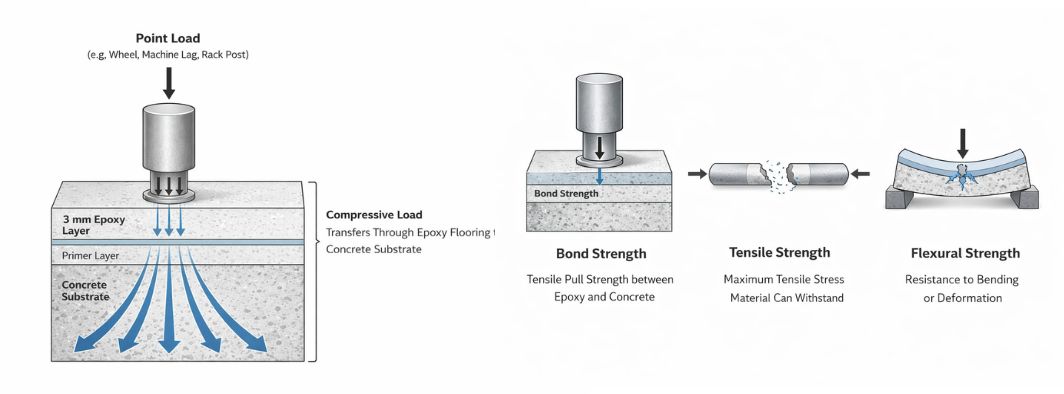
Load transfer behaviour in thin Resin flooring systems
In Resin flooring systems of approximately 1-4 mm thickness, the resin layer behaves as a bonded surface membrane, not as a structural element.
Load transfer mechanism:
- Loads applied at the surface (foot traffic, trolleys, forklifts, equipment legs) create localized stress
- Due to the small thickness and high modulus of Resin, compressive stress passes almost vertically through the Resin layer
- The Resin cannot laterally disperse load in any meaningful way
- Upon reaching the substrate, stress spreads within the M25 (or higher) concrete as a stress cone
As a result:
- Compressive stresses do not accumulate within the Resin
- Performance is governed by bond integrity and material toughness, not resin compressive strength
- Increasing Resin compressive strength does not increase floor load capacity.
Why Resin floors actually fail
Field experience and failure investigations consistently show that thin Resin floors fail due to:
- Weak or low-strength concrete / screed
- Poor surface preparation or residual laitance
- Low surface tensile (pull-off) strength
- Moisture vapor pressure or rising damp
- Impact and dynamic loading
- Excessive rigidity and poor flexural compatibility
Not due to insufficient compressive strength of the Resin material.
A critical misconception is that a high-strength resin can compensate for a weak substrate. In reality:
- A 90 MPa Resin over an M15 substrate will fail
- A 60 MPa Resin over a sound M30 substrate will perform reliably
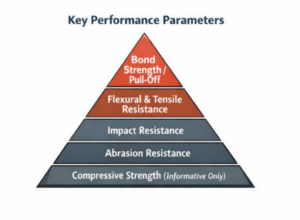
Critical parameters that truly govern Resin flooring performance
For Resin coatings and self-leveling systems (1–4 mm), the following parameters are decisive:
Surface tensile / pull-off strength
- Governs adhesion and durability
- Typically ≥ 1.5 MPa
- Most common point of failure in thin resin floors
Flexural strength & modulus compatibility
Enables accommodation of:
- Micro-deflections
- Thermal movement
- Substrate strain
- Overly rigid systems crack even on good substrates
Tensile behaviour
- Controls resistance to shrinkage and movement-induced stresses
- Directly related to crack initiation and propagation
Impact resistance
- Critical for industrial and logistics environments
- Determines resistance to tool drops, pallet impacts, and forklift shock
- A resin may have high compressive strength but fail due to brittleness
Abrasion resistance
- Governs long-term service life
- Controls wear under traffic and cleaning regimes
- Determines when the floor actually needs replacement
Substrate compressive strength
- Minimum recommended: M25
- Ensures stable stress dispersion and long-term bond retention
What Actually Causes Resin Floor Failures
| Failure Mode | Root Cause |
| Delamination | Poor tensile / bond strength |
| Cracking | Low flexural strength |
| Chipping | Poor impact resistance |
| Wear & dusting | Low abrasion resistance |
Why compressive strength is overstressed in datasheets
Compressive strength continues to dominate resin flooring discussions because it is:
- Familiar to civil engineers
- Easy to measure and standardize
- Numerically impressive and easy to compare
However, for thin resin flooring systems:
Compressive strength is an intrinsic material property, not a system performance parameter.
When compressive strength does matter
Compressive strength becomes a meaningful design consideration only when:
- Resin screeds ≥6–9 mm thickness are used
- The flooring layer contributes to load distribution
- High point loads and heavy impact are expected
In such systems, compressive strength forms part of a broader mechanical performance assessment, not a standalone criterion.
Conclusion
Thin resin floors are performance systems, not structural layers. Their durability depends on how effectively they:
Bond to the substrate
Accommodate movement
Absorb impact
Resist abrasion over time