Introduction
Industrial facilities today demand high-performance flooring systems that can withstand heavy traffic, machinery loads, and continuous operations. Resin flooring systems such as epoxy, polyurethane (PU), and PU screed are widely used in manufacturing plants, warehouses, logistics hubs, and pharmaceutical facilities because of their durability and chemical resistance.
However, the performance of any resin flooring system depends significantly on the quality of the concrete substrate beneath it.
One of the most effective methods to achieve a high-quality concrete base is through laser screed technology. Laser screed concrete provides improved flatness, better level control, and consistent surface quality, making it an ideal base for resin flooring systems.
What is Laser Screed Concrete?
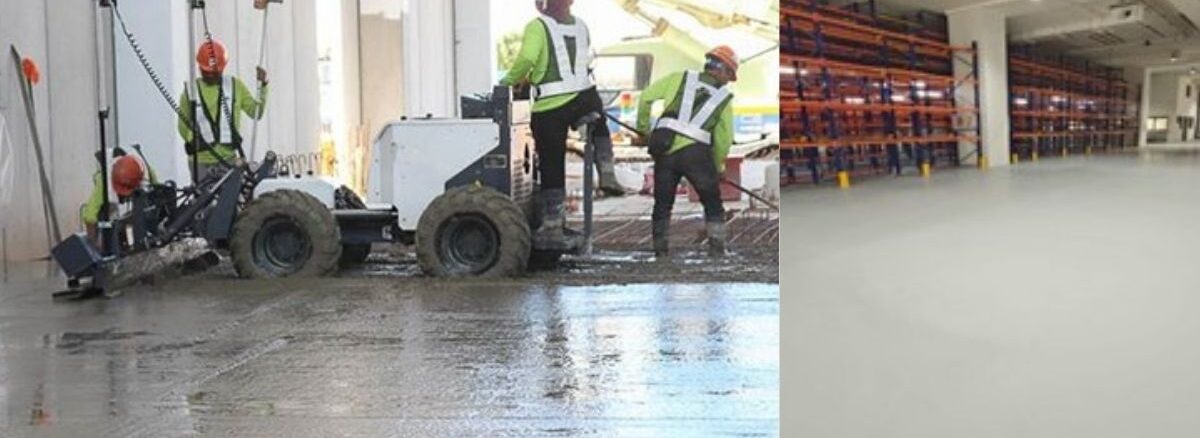
Laser screed is an advanced concrete placement and levelling technology that uses laser-guided equipment to achieve precise floor levels and high surface flatness.
The system uses a laser transmitter and receiver to guide a screed head that spreads and levels freshly poured concrete automatically.
Compared with conventional concrete finishing methods, laser screed produces floors with:
- Higher flatness (FF) values
- Better levelness (FL) control
- Uniform slab thickness
- Reduced manual finishing errors
These characteristics make laser screed floors particularly suitable for industrial flooring applications and resin coatings.
Why Substrate Quality Matters for Resin Flooring
Resin flooring systems typically range from 1 mm to 6 mm thickness depending on the system type. Because these systems are relatively thin compared to the concrete slab, any irregularities in the base slab will directly affect the final floor performance.
Poor base concrete can result in:
- Uneven resin thickness
- Increased material consumption
- Visible surface undulations
- Premature wear in high spots
- Difficulty in achieving aesthetic finish
Therefore, the quality of the concrete base slab plays a critical role in determining the durability and appearance of the finished resin floor.
Key Benefits of Laser Screed Concrete for Resin Flooring
- Superior Surface Flatness
Laser screed technology produces significantly flatter concrete surfaces compared to conventional hand-screeded floors.
A flatter slab results in:
- Uniform resin thickness
- Better aesthetics
- Reduced risk of thin areas that may fail under traffic
For large industrial facilities such as warehouses and manufacturing plants, floor flatness is especially important for forklift operations and automated material handling systems.
- Reduced Surface Grinding
Surface preparation is an essential step before installing resin flooring. Typically, the concrete surface needs to be diamond ground or Scarified/shot blasted to remove laitance and create a suitable bonding profile.
When laser screed concrete is used:
- Surface irregularities are minimal
- Grinding time is reduced
- Labor costs are lower
- Project timelines improve
This results in faster project execution without compromising floor quality.
- Consistent Slab Thickness
Laser screed equipment ensures that the concrete slab maintains uniform thickness across the entire floor area.
Uniform thickness leads to:
- Better structural performance
- Reduced cracking risk
- Improved load distribution
A stable concrete base provides an ideal platform for resin flooring systems to perform effectively over the long term.
- Improved Resin Material Efficiency
Uneven base slabs often require additional resin material to fill depressions and level the surface.
Laser screed concrete reduces such variations, which results in:
- Controlled resin consumption
- Reduced wastage
- Better cost predictability for flooring systems
This can significantly impact the overall flooring budget, especially in large industrial projects covering thousands of square meters.
- Better Floor Performance in High-Traffic Areas
Industrial floors are subjected to heavy loads from:
- Forklifts
- Pallet trucks
- Automated guided vehicles
- Heavy machinery
When resin flooring is installed over a flat and well-finished laser screed slab, the floor performs more consistently under traffic loads.
This reduces issues such as:
- Abrasion in high spots
- Premature wear
- Surface damage due to uneven stress distribution
Typical Applications Where Laser Screed Concrete is Beneficial
Laser screed concrete is widely used in facilities that require high-quality industrial flooring, including:
- Warehouses and logistics centres
- Automotive manufacturing plants
- Electronics manufacturing facilities
- Pharmaceutical plants
- Food processing facilities
- Distribution centres
In these environments, combining laser screed concrete with resin flooring systems provides a durable and long-lasting floor solution.
Best Practices for Consultants and Project Teams
For consultants and project managers specifying resin flooring systems, it is important to ensure the following:
- Concrete slab flatness meets required FF/FL standards
- Concrete grade is typically M25 or higher
- Proper curing is completed before flooring installation
- Surface preparation methods are clearly defined
- Joints are planned and detailed properly
Early coordination between civil contractors, flooring specialists, and consultants helps ensure that the base slab meets the requirements for successful resin flooring installation.
Conclusion
Laser screed technology significantly improves the quality of concrete floors used in industrial facilities. By providing superior flatness, consistent slab thickness, and reduced surface irregularities, it creates an ideal substrate for resin flooring systems.
For projects where durability, aesthetics, and long-term performance are important, specifying laser screed concrete combined with high-performance resin flooring is a reliable and cost-effective solution.
In industrial flooring, the quality of the final floor is only as good as the concrete base beneath it.
Compiled By : Raj V R, Flooring Consultant, GM – Techno commercial – APTPL , Contact : 9972582346 Email : vasu.raj@aptpl.in